


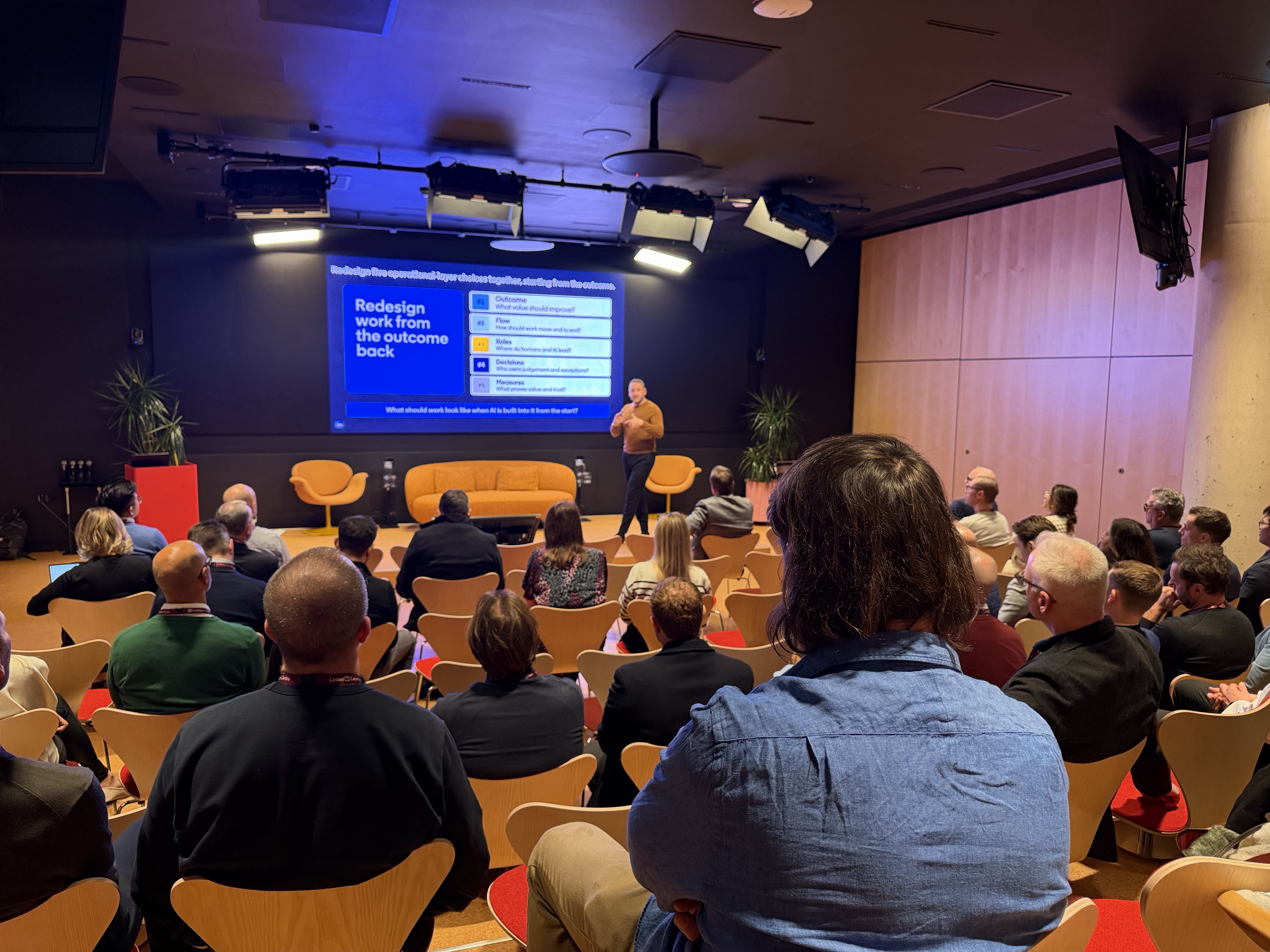
On Tuesday 24 November, APSCo OutSource and APSCo UK brought members together at LinkedIn’s Experience Centre in Farringdon for an afternoon of leadership, discussion and networking.
Brian Huggett, Managing Director of APSCo OutSource, opened the event with reflections on the year, (including his disappointment about not being cast as the next James Bond) before introducing our speakers.
Adam Hawkins, Head of Search & Staffing, EMEA & LATAM at LinkedIn, opened with a keynote titled The Work is Still Frozen. His central point was that technology and employee expectations have moved quickly, while many of the processes around work have stayed much the same.
LinkedIn research shared during the session showed that 80% of organisations are exploring, experimenting with or integrating generative AI, but only 11% have integrated it into how work is done. The challenge for staffing businesses is to move beyond adding tools to existing processes and rethink how work flows across the recruitment lifecycle.
That means looking beyond technology. Legacy processes, siloed ownership, skills, decision-making and established ways of working can all slow progress. Adam encouraged leaders to start with the outcome they want to improve, then consider how workflows, roles, decisions and measures need to change to achieve it.
The session also explored how recruiter roles could evolve. As AI takes on tasks such as finding patterns, drafting and coordination, human expertise can be focused where it matters most: framing the right questions, applying judgement, building relationships and taking responsibility. In a market where AI-generated applications and impersonation are increasing, trust and the ability to demonstrate authenticity also become part of the service recruitment firms provide.
Moving from pilots to lasting change
Adam outlined an approach to moving from isolated pilots to organisational change: diagnose where friction exists, redesign tasks and decisions, then scale what works through training, governance and standardised practices.
The message was to begin with one workflow and learn from the people closest to it. Clear outcomes and measures can help businesses assess whether a change is improving quality, speed and trust, as well as saving time.
Max Evans, Associate Director, Consulting, People & Change at RSM UK, and Michael Wang, Consulting Director and Workforce Solutions co-lead at RSM, continued the discussion in a presentation titled From Workforce Shift to Business Value.
They described the risk of “AI cosplay”: appearing to be an AI-enabled business because tools have been purchased and pilots launched, while the underlying workflows, targets and incentives remain unchanged. The Access Group research cited in their presentation found that 78% of recruitment agencies had adopted AI in some form, while 6% had embedded it in their core operating model.
Max also highlighted the importance of bringing employees into the change. People may be reluctant to share how they use AI if they are unsure what it means for their role, targets or performance expectations. Businesses can help close that gap by setting clear rules for using candidate and client data, explaining what happens to time saved, recognising shared methods and quality, and equipping managers to coach teams through changes to their work.
Data underpins better decisions
Michael Wang focused on the role of data in productivity, reporting confidence, scalability and business value. Data held across disconnected systems, inconsistent records and manual processes can make it harder to understand performance and limit the benefits of AI.
The session encouraged leaders to review where data is created and used across the recruitment lifecycle, how it moves between systems, which processes still rely on spreadsheets, and who is responsible for its quality and governance. Accurate, complete and consistent data helps businesses make better decisions and plan future technology with greater confidence.
Across both presentations, the message was clear: AI creates value when businesses redesign the work around it. That takes engaged people, trusted data and a focus on better outcomes for clients and candidates.
The afternoon concluded with beers, canapés and time to continue the conversation.
Thank you to our speakers as well as LinkedIn for sponsoring and hosting us.